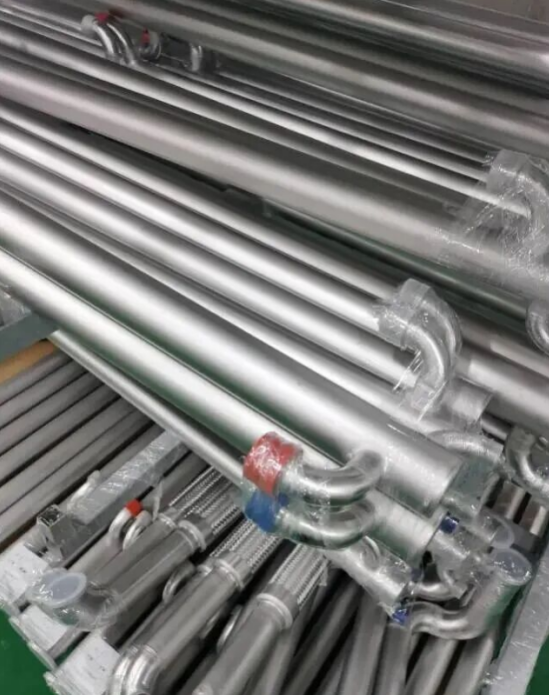

Judgment criteria and identification methods for "over-pickling" on stainless steel surfaces
Release time:2026-05-20
Page views:0
In the pickling process of austenitic stainless steel, operators often believe that "the more thorough the pickling, the cleaner the surface, and the better the passivation effect". However, this has always been perceived as potentially leading to a hidden and dangerous process deviation - excessive acid washing. Excessive acid washing not only fails to improve corrosion resistance, but also damages the original structure of stainless steel surface, inducing intergranular corrosion, surface roughness, and even irreversible damage such as hydrogen embrittlement. So, how to determine if stainless steel is "over pickled"?
Acid washing is the use of acid to remove the oxide scale, heat affected zone oxidation color, and surface iron filings on the surface of stainless steel. Within a certain time, concentration, and temperature range, acid washing can obtain a clean and uniform active surface. But when the pickling conditions exceed a certain threshold - too long a time, too high an acid concentration, too high a temperature, or the acid contains highly corrosive impurities - the pickling reaction evolves from "removing oxide scale" to "excessively eroding the base metal", that is, pickling is excessive. The essence of excessive acid washing is that the dissolution rate of the acid solution on the stainless steel substrate exceeds the expected rate of oxide scale removal, resulting in indiscriminate corrosion of the substrate metal. This type of corrosion may exhibit uniform thinning, or it may preferentially develop along grain boundaries (intergranular corrosion), or form local defects such as pitting and grooves. After excessive pickling, a series of visible or microscopic abnormal morphologies will appear on the surface of stainless steel. The following characteristics can be used as a basis for preliminary on-site judgment: the surface is dull and lacks luster: it loses the silver white metallic luster that stainless steel should have, presenting a uniform dull or gray black color, similar to a "dead ash" shape.
Grain exposure/orange peel like: Grains protrude due to preferential corrosion at grain boundaries, presenting a rough texture similar to orange peel or crystalline grains on the surface. Intergranular cracks or network patterns: filamentous network cracks appear at grain boundaries (visible under low magnification), and in severe cases, they can be felt rough by hand. Pitting pits: tiny corrosion holes scattered on the surface, with diameters ranging from a few micrometers to tens of micrometers. Size deviation: The threads, apertures, and sealing surfaces of precision fit exceed the tolerance range due to excessive thinning. Black gray/hanging gray residue: After excessive acid washing, a layer of difficult to wash black or gray black loose layer often adheres to the surface, composed of insoluble residues such as carbides and intermetallic compounds. Among them, "grain exposure" and "network intergranular lines" are the most characteristic signs of excessive acid washing, often indicating that intergranular corrosion has occurred.
Excessive acid washing can significantly increase surface roughness. Measure using a surface roughness meter:
Ra value: The Ra value on the surface of stainless steel after normal pickling is generally 0.2-0.8 μ m. If Ra>1.6 μ m and the surface exhibits obvious peak valley structures, it can be judged as excessive.
SEM observation: Normal surfaces should be flat with slight uniform erosion; The excessive surface displays grain boundary deep grooves, grain protrusions, and even pores with grain detachment.
For frontline operators and quality inspectors, preliminary diagnosis can be completed without the need for complex equipment. The first step is to visually inspect the surface under sufficient light (preferably with a magnifying glass). If obvious grain contours or mesh like fine lines can be seen, immediately mark it as suspicious excessive. Step 2: Use a white dust-free cloth dipped in deionized water to wipe the surface during the wiping test. If the cloth is contaminated with black or dark gray powder (metal corrosion debris) and the surface remains dull and dull after wiping, it indicates excessive dissolution of the substrate. Step 3: Copper sulfate drip test
Add copper sulfate solution dropwise onto the surface according to ASTM A967 requirements. If a red copper deposition layer appears within 1 minute, it indicates an abnormally high surface free iron content - excessive acid washing has damaged the passivation film and exposed the iron rich substrate. Excessive acid washing is not simply about "unsightly surface", it may bring serious service risks:
The sensitivity to intergranular corrosion significantly increases, leading to rapid cracking along grain boundaries in corrosive media.
The pitting potential decreases and the resistance to chloride ion erosion decreases.
The risk of hydrogen embrittlement is increasing.
Excessive size deviation leads to assembly failure or leakage.
The concept of "excessive pickling" on the surface of stainless steel is not vague, but a set of quantifiable criteria for judgment. From the macroscopic dark surface and grain exposure, to the microscopic grain boundary grooves, excessive weight loss, and failure of intergranular corrosion tests, these indicators together constitute a step-by-step diagnostic system from "suspicious" to "confirmed". While pursuing a "clean" surface, we must also be wary of "going too far" - moderate acid washing can obtain a clean and active surface, while excessive acid washing can open the door to intergranular corrosion. Mastering these judgment criteria is a fundamental skill for on-site engineers to control the quality of acid pickling and avoid batch accidents.